
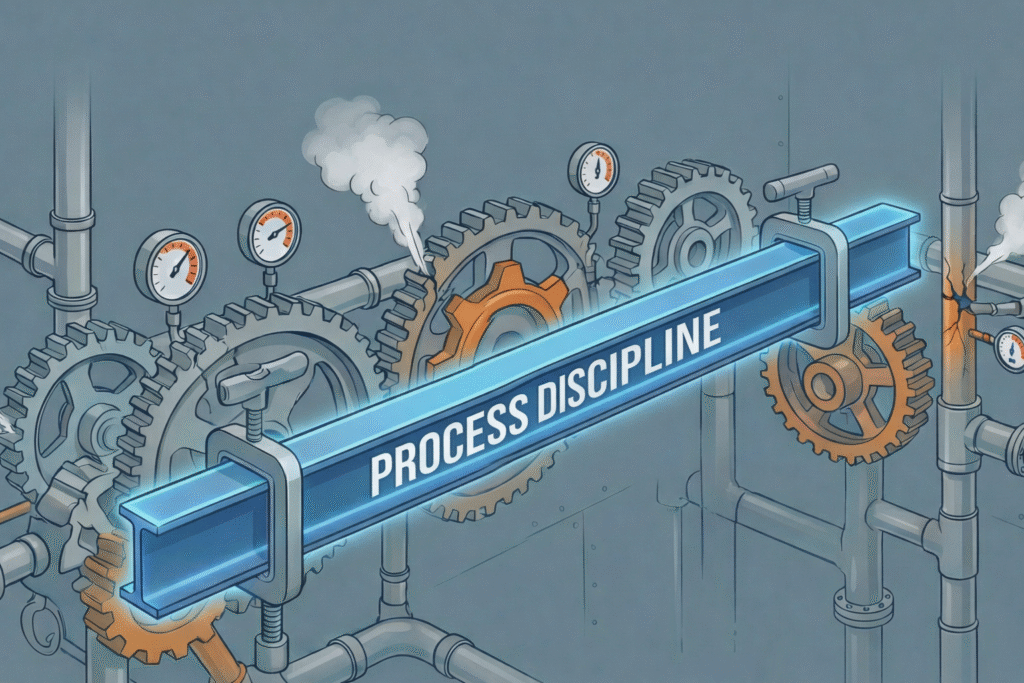
Most organisations only truly understand their processes when those processes are under stress.
In calm conditions, workarounds are invisible.
Delays are tolerated.
Manual steps are absorbed quietly by capable people doing their best.
But when in pressure rises, demand spikes, resources tighten, consequences become immediate and weaknesses surface fast.
Few environments illustrate this more clearly than an Emergency Department.
Why Emergency Departments Matter to Every Leader
Emergency Departments operate at the intersection of:
- unpredictable demand,
- finite capacity,
- high consequences,
- and constant decision-making under pressure.
Sound familiar?
While most organisations aren’t dealing with life-or-death outcomes, many face their own versions of:
- surges in demand,
- constrained resources,
- fragmented handovers,
- and decisions made with incomplete information.
That’s why EDs are such a powerful lens for understanding process performance.
They don’t fail because people don’t care.
They struggle when systems rely too heavily on heroics and not enough on structure.
Pressure Doesn’t Create Problems, It Reveals Them
When systems are under strain, three things tend to become obvious very quickly:
- Bottlenecks move from theoretical to real
Delays that were previously hidden suddenly block flow. - Handoffs become fragile
Information gaps, unclear ownership, and rework multiply. - Decision-making slows or fragments
When roles and criteria aren’t clear, choices default to escalation or delay.
None of these issues are unique to healthcare.
They exist in supply chains, operations centres, customer service teams, manufacturing lines, and transformation programs everywhere.
Pressure simply removes the buffer that once hid them.
Why More Effort Is Not the Answer
In high-pressure environments, the instinctive response is to ask people to:
- work harder,
- move faster,
- be more flexible.
In the short term, this can help.
In the long term, it creates fragility.
When systems depend on individual effort rather than process clarity:
- performance becomes inconsistent,
- burnout increases,
- and improvement becomes reactive rather than intentional.
Emergency Departments don’t improve sustainably by asking clinicians to care more.
They improve when flow is designed, roles are clear, and decisions are supported by structure.
The same is true in any organisation.
Process Discipline as a Stabilising Force
Well-designed processes don’t slow teams down under pressure, they stabilise them.
Disciplined processes:
- reduce cognitive load,
- make prioritisation visible,
- clarify decision rights,
- and allow people to focus on judgment rather than coordination.
This is where frameworks like DMAIC matter, not as bureaucracy, but as thinking scaffolds:
- Define what problem actually needs solving,
- Measure where flow breaks down,
- Analyse causes rather than symptoms,
- Improve in ways that restore flow,
- Control so gains don’t evaporate under the next surge.
Under pressure, structure becomes freedom.
Where AI Adds Value and Where It Doesn’t
AI is often introduced into high-pressure systems with the promise of speed:
- faster triage,
- faster routing,
- faster decisions.
But speed alone doesn’t resolve congestion.
AI is most effective when it:
- makes demand visible,
- highlights emerging bottlenecks,
- supports prioritisation,
- and reinforces agreed process logic.
What AI cannot do is compensate for:
- unclear process boundaries,
- inconsistent handovers,
- or undefined decision criteria.
In environments like Emergency Departments and in organisations more broadly, AI works best as a process amplifier, not a process substitute.
The Lesson Leaders Often Miss
The environments that feel the most chaotic are rarely the ones with the weakest people.
They are usually the ones where:
- demand variability isn’t designed for,
- process logic lives in people’s heads,
- and decision-making depends on experience rather than structure.
Emergency Departments don’t need more dedication.
They need systems that support good decisions when time, capacity, and attention are scarce.
So do most organisations.
Looking Ahead
In the coming days, we’ll explore Emergency Departments as a practical case study, not to critique healthcare, but to understand how process, flow, and decision design behave under extreme pressure.
The lessons apply far beyond hospitals.
Because when pressure rises, the question isn’t:
Do people care enough?
It’s:
Does the system support them when it matters most?
A final reflection
Pressure doesn’t break systems.
It reveals whether they were ever designed to hold.