
In a world where businesses are under pressure to do more with less, process improvement frameworks are no longer optional – they are strategic assets. And among them, few are as widely trusted as DMAIC.
Originally formalised within Lean Six Sigma, DMAIC remains the backbone of structured, repeatable improvement work. But in 2025, leaders are asking a different set of questions:
- Is DMAIC still relevant in the era of automation?
- How does AI enhance DMAIC instead of replacing it?
- How can teams accelerate improvement work without sacrificing rigor?
This guide breaks down DMAIC in a modern context – clear, practical, and aligned with the way today’s teams actually work.
🔵 What is DMAIC? A Modern Definition
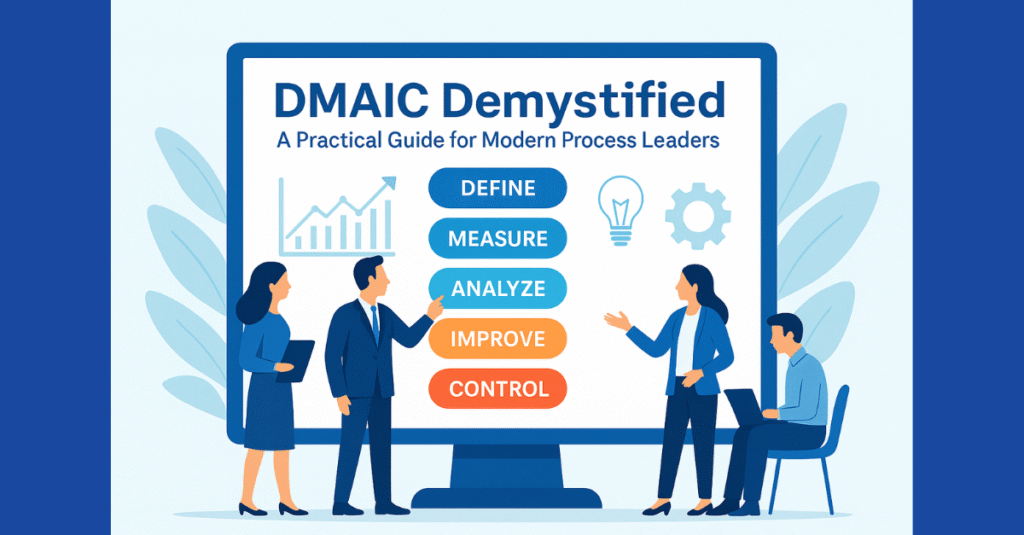
DMAIC stands for:
- Define
- Measure
- Analyse
- Improve
- Control
It is a structured, five-phase method used to solve process problems systematically. But the modern view of DMAIC is not just a sequence – it’s a mindset:
DMAIC is a disciplined way of making decisions based on data, not opinion – and improving processes in a way that sticks.
This alone sets high-performing organisations apart from those that rely on intuition, guesswork, or heroics.
🔹 Why DMAIC Still Matters in 2025
Despite advances in AI and automation, DMAIC has become more relevant, not less.
Here’s why:
1. AI cannot fix a poorly defined problem
As shared in our earlier article,
👉 The Real Cost of Broken Processes
many inefficiencies stem from unclear problem statements and inconsistent processes.
DMAIC enforces clarity from day one.
2. AI accelerates DMAIC – it doesn’t replace it
Modern leaders use AI to:
- Analyse root cause data
- Suggest solutions
- Standardise documentation
- Speed up insights
But DMAIC is the structure that ensures AI outputs are valid, useful, and aligned with business goals.
3. DMAIC standardises cross-functional work
Teams move faster when they share:
- A common language
- A common structure
- A common set of expectations
AI helps them execute – DMAIC keeps them aligned.
🟦 Phase 1: Define – Clarify the Problem, Scope & Customer Impact
The Define phase lays the foundation for everything that follows.
Strong Define work prevents wasted time, scope creep, and incorrect solutions.
In 2025, Define has three essential components:
1. A clear, data-backed problem statement
A good problem statement answers:
- What is happening?
- Where is it happening?
- When does it occur?
- How big is the impact?
- Who is affected?
2. Alignment on the true objective
Teams must agree on:
- The real business problem
- The value of solving it
- The boundaries of the project
3. A high-level SIPOC to map the process
Today, leaders use platforms like ProcessPartner.AI to automatically create SIPOCs and Process Maps based on structured prompts – impossible five years ago.
👉 Related reading:
“How AI is Re-Engineering Process Improvement”
🟩 Phase 2: Measure – Quantify the Current State
Measure is where you establish baseline performance.
Without data, you’re just guessing.
Modern Measure work includes:
- Identifying what to measure (CTQs, cycle time, errors, cost, delays)
- Validating data quality and sources
- Assigning real costs to process waste and defects
- Confirming effectiveness & efficiency of current Process steps
AI tools simplify data collection, automate calculations, and reduce preparation time dramatically – but they still depend on Measure being done correctly.
🟨 Phase 3: Analyse – Identify the Root Causes
Analyse is often where teams derail.
They jump to solutions instead of uncovering the causes.
Modern Analyse methods include:
- Identifying waste and impacts
- Fishbone analysis
- 5 Whys
- Regression analysis
- Root Cause Hypothesis
AI accelerates root-cause detection, but humans provide context.
Together, they form a powerful partnership.
🟧 Phase 4: Improve – Implement, Validate & Optimise Solutions
Improve is where value is created.
Typical 2025 Improve activities include:
- Co-designing new process steps
- Simulating workflows
- Testing automation in controlled environments
- Prototyping solutions
- A/B testing improvements
- Running pilot groups
With platforms like ProcessPartner.AI, teams can iterate far more rapidly, leveraging templates, AI-generated Insights, and guided workflows.
🟥 Phase 5: Control – Lock In Gains & Prevent Regression
Many improvements fail because the Control phase is neglected.
Modern Control requires:
- Updated standard operating procedures (SOPs)
- Visual dashboards and KPIs
- Monitoring plans
- Owner accountability
- Automated alerts when performance deviates
In a fast-moving world, Control isn’t just “document and close.”
It’s an active discipline that protects value long-term.
🔄 DMAIC + AI: The New Standard
DMAIC provides structure.
AI provides speed.
Together, they create a new category of improvement capability:
Fast, accurate, scalable process improvement without sacrificing rigour.
ProcessPartner.AI extends DMAIC by providing:
- Automated templates
- AI-generated seed data
- Auto-mapped SIPOCs
- Built-in knowledge bases
- Centralised project storage
- Regeneration of outputs as projects evolve
This transforms DMAIC from a slow, manual method into an agile, iterative workflow.
🧭 Where Modern Leaders Should Begin
If you want DMAIC to work in your organisation:
- Start with small, well-defined projects.
- Focus on measurable outcomes.
- Use AI tools to accelerate the work.
- Build a culture of continuous improvement – not one-off “fix it” projects.
- Standardise your templates and workflows.
Your future projects will thank you.
🚀 Final Thoughts
DMAIC isn’t old – it’s evolved.
In a digital and AI-driven world, it remains the most effective framework for solving complex problems, reducing inefficiency, and scaling operational excellence.
Whether you’re a consultant, an operations leader, or a business owner, DMAIC gives you the structure.
AI gives you the power.
ProcessPartner.AI gives you both in one secure platform.
✨ Ready to accelerate your next improvement project?
👉 Start free with ProcessPartner.AI – generate your first SIPOC in minutes.
👉 Watch our DMAIC explainer videos on YouTube.