
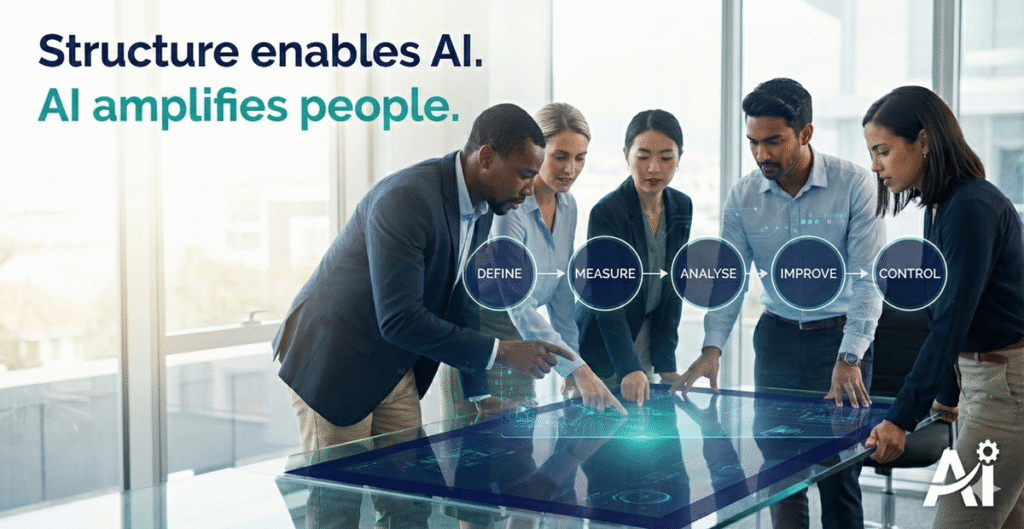
Artificial intelligence is no longer experimental.
Across industries, leaders are investing heavily in AI to drive efficiency, automate work, and unlock new forms of innovation.
But there’s a hard truth emerging beneath the hype:
AI deployed without strong process discipline doesn’t fix problems — it accelerates them.
When poorly defined, inconsistent, or broken processes are automated, AI simply makes the chaos faster, larger, and harder to unwind. Real innovation only happens when AI is built on a foundation of structured, disciplined processes.
AI Is Powerful — But It Needs Structure
AI excels at speed, repetition, and scale.
It can process vast datasets, automate routine tasks, and generate insights far faster than any human team.
What it cannot do is:
- define meaningful problems,
- understand organisational nuance,
- apply judgment, empathy, or strategic intent.
That’s where people remain essential.
The real opportunity is not replacing humans with AI, but using AI to remove friction, freeing people to focus on creativity, problem-solving, and value-creating work. When that balance is right, AI becomes a force multiplier. When it’s wrong, it becomes an amplifier of inefficiency.
The Hidden Cost of Automating Disorder
Many organisations rush into AI adoption hoping for quick wins — faster processes, lower costs, or rapid automation.
When underlying processes are unclear or unstable, the result is predictable.
Automated chaos shows up as:
- Higher operational costs due to rework and error propagation
- Frustrated teams forced to manage AI-driven exceptions
- Inconsistent customer experiences at greater scale
- Stalled innovation, as effort shifts from improvement to recovery
AI systems learn from the data and workflows they’re given. If those inputs are flawed, AI doesn’t correct them — it reproduces and magnifies them.
Without discipline, you’re effectively adding a jet engine to a car with square wheels.
Why Process Discipline Is the Missing Link
True innovation depends on process maturity.
Disciplined processes:
- create consistency,
- establish clear ownership,
- define measurable outcomes,
- and provide a stable environment for automation.
This is where structured improvement frameworks become essential — not as bureaucracy, but as enablers of speed and scale.
DMAIC: Enabling Human–AI Collaboration
One of the most effective frameworks for building this discipline is DMAIC
(Define, Measure, Analyse, Improve, Control).
DMAIC isn’t just a project methodology — it’s a way of thinking that aligns human judgment with data-driven execution.
Here’s how it enables productive human–AI collaboration:
Define
Humans clarify the problem, set direction, and interpret customer needs.
AI can support this by scanning historical data and surfacing patterns, but purpose and intent remain human decisions.
Measure
AI excels at collecting, cleaning, and analysing performance data in real time — work that previously consumed weeks of manual effort.
Analyse
Humans interpret insights, test hypotheses, and apply contextual understanding.
AI strengthens this phase through statistical analysis, pattern recognition, and correlation discovery.
Improve
People design solutions, experiment, and lead change.
AI can simulate scenarios, predict outcomes, and optimise options before changes are rolled out.
Control
Humans define governance and standards.
AI continuously monitors performance, flags deviations, and supports sustained improvement.
Together, this structure turns improvement from an ad-hoc effort into a repeatable capability.
Competitive Advantage Comes from Discipline
Organisations that embed process discipline into their operating model gain advantages that compound over time:
- Agility – Faster identification and resolution of issues
- Innovation capacity – More time spent creating, less time firefighting
- Talent retention – Clear processes supported by intelligent tools attract high performers
- Customer trust – Consistent, reliable experiences at scale
- Financial flexibility – Reduced waste enables competitive pricing or stronger margins
This is how innovation scales — not through isolated AI pilots, but through disciplined execution.
Where ProcessPartner.AI Fits
At ProcessPartner.AI, this is exactly the problem we focus on solving.
We help organisations embed process discipline faster by combining:
- AI-seeded DMAIC templates
- guided workflows
- structured problem definition
- centralised improvement artefacts
The result is a platform that supports Define → Measure → Analyse → Improve → Control in a way that is structured, repeatable, and scalable — with AI accelerating the work, not replacing the thinking.
Building the Right Foundation for AI Success
AI’s true value isn’t in performing tasks — it’s in elevating organisational capability.
That elevation only happens when strong processes are in place. Without them, AI magnifies inefficiency. With them, AI unlocks speed, insight, and innovation that simply wasn’t possible before.
Continuous improvement is no longer optional.
For organisations navigating AI-driven change, it’s a survival strategy.
Want to see how disciplined, AI-assisted improvement actually works?
Explore ProcessPartner.AI and see how structured frameworks and intelligent tools can work together to deliver real, repeatable innovation.