
Process improvement leadership is the difference between isolated projects and a capability that actually sticks. Most leaders believe they’re already doing process improvement.
They’ve invested in systems.
They’ve run workshops.
They’ve sponsored initiatives.
They’ve asked teams to “work smarter.”
And yet, in many organisations, the same issues keep resurfacing — delays, rework, inconsistent outcomes, and improvement efforts that struggle to stick.
The problem isn’t lack of intent.
It’s a misunderstanding of what process improvement actually requires at a leadership level.
The Common Misconception: Process Improvement Is a Project
One of the most persistent mistakes leaders make is treating process improvement as a project rather than a capability.
Projects have:
- a start and end date,
- a defined scope,
- a team assigned to “fix the problem,”
- and a handover once the work is done.
Capabilities, on the other hand:
- shape how work is done every day,
- evolve continuously,
- and become embedded in decision-making.
When improvement is framed as a project, teams focus on delivery.
When it’s treated as a capability, teams focus on learning.
That difference matters more than most leaders realise.
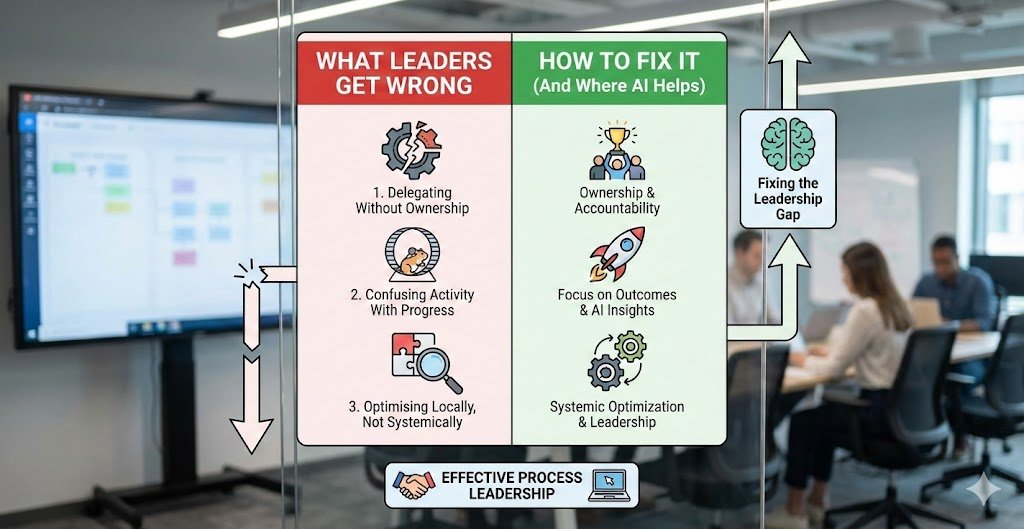
Mistake #1: Delegating Improvement Without Ownership
Many leaders “support” process improvement by delegating it.
They assign it to:
- a transformation office,
- a Lean team,
- or a small group of specialists.
While expertise is important, delegation without ownership sends a subtle message:
Improvement is someone else’s responsibility.
In organisations where improvement succeeds, leaders don’t just sponsor it — they model it.
They:
- ask disciplined questions,
- insist on clarity before speed,
- and treat process thinking as part of leadership, not an add-on.
Mistake #2: Confusing Activity With Progress
Another common trap is mistaking visible activity for real improvement.
Workshops are held.
Maps are drawn.
Dashboards are built.
But when outcomes don’t change, frustration sets in.
True improvement isn’t measured by how much work happens — it’s measured by:
- reduced friction,
- improved flow,
- clearer decision paths,
- and more predictable outcomes.
Without a clear link between effort and impact, improvement becomes theatre rather than progress.
Mistake #3: Optimising Locally, Not Systemically
Leaders often encourage teams to “fix what’s in front of them.”
While well-intentioned, this can lead to:
- siloed optimisation,
- conflicting priorities,
- and improvements that shift problems rather than solve them.
Processes don’t fail in isolation.
They fail at handoffs, interfaces, and boundaries.
Effective leaders look beyond local efficiency and ask:
- where work slows down,
- where decisions get stuck,
- and where accountability becomes unclear.
That requires a system-level view — not just local fixes.
Where AI Changes the Stakes
As AI becomes embedded in everyday work, these leadership gaps become more visible.
AI accelerates execution.
It surfaces patterns.
It removes friction from repetitive tasks.
But it also exposes:
- unclear decision rights,
- inconsistent processes,
- and weak problem definition.
In this environment, AI doesn’t compensate for poor leadership — it amplifies it.
Leaders who lack process discipline will see AI magnify confusion.
Leaders who value structure will see AI unlock speed and insight at scale.
Process Improvement Leadership Is a Capability, Not a Project
Leaders who get process improvement right tend to share a few behaviours:
- They insist on clear problem definition before action.
- They treat data as a tool for learning, not justification.
- They reward teams for improving flow, not just hitting targets.
- They view frameworks like DMAIC as thinking tools, not bureaucracy.
- They understand that improvement is never “done.”
Most importantly, they create environments where:
structure enables speed, rather than slowing it down.
Fixing the Leadership Gap
Fixing what leaders get wrong about process improvement doesn’t require more tools or more initiatives.
It requires a shift in mindset:
- from delivery to learning,
- from delegation to ownership,
- from episodic change to continuous capability.
Process improvement works when leaders treat it as part of how the organisation thinks — not just how it executes.
Looking Forward
As organisations move deeper into AI-enabled ways of working, process leadership will become even more critical.
The leaders who succeed won’t be those with the most automation.
They’ll be the ones who combine:
- human judgment,
- disciplined thinking,
- and intelligent acceleration.
That combination is where improvement stops being fragile — and starts becoming durable.
A final reflection
If process improvement in your organisation feels harder than it should, the issue may not be effort or intent.
It may be that leadership expectations haven’t caught up with what improvement actually demands.
And that’s a fixable problem.