
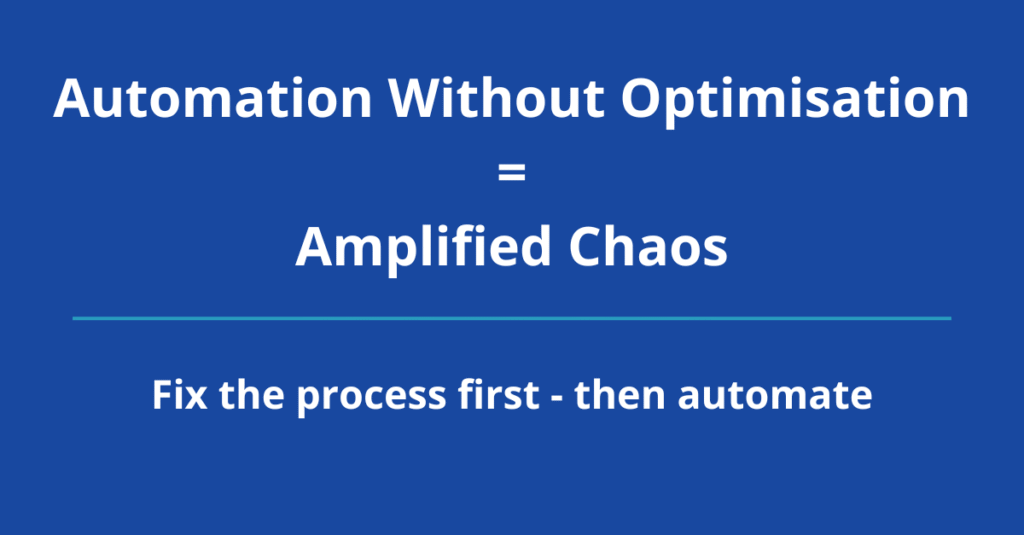
The Promise — and Peril — of Easy Automation
In recent years, automation has gone from a buzzword to a daily reality. Tools like Zapier, UiPath, Power Automate, Make, and countless AI assistants now make it possible for anyone — from a small business owner to a global enterprise — to automate complex workflows with just a few clicks.
But here’s the uncomfortable truth: if you automate a process that isn’t optimised, you’re not improving efficiency — you’re amplifying chaos.
Automation doesn’t fix broken processes. It accelerates them. And that’s a dangerous problem more businesses are walking into without realising it. AI process improvement can transform efficiency — but only if your workflows are stable before automation.
Automation Magnifies Whatever It Touches
Think about it this way: automation is a multiplier. If your process is well-designed — streamlined, consistent, and error-free — automation will magnify that success. You’ll save time, reduce waste, and achieve measurable gains in productivity.
But if your process is inefficient — full of delays, rework, unclear handoffs, or missing data — automation will magnify those problems too. You’ll produce bad outcomes faster, at greater scale, and with less visibility into what went wrong.
“Automation magnifies both value and waste. The difference is whether the process was ready.”
Businesses often confuse speed with efficiency, and that’s where the trouble begins. True efficiency only comes from clarity, standardisation, and measurement — the hallmarks of process optimisation.
The Hidden Cost of Automating Chaos
When businesses rush to automate without understanding their underlying workflows, they often experience three types of pain:
- Waste: Instead of removing non-value-adding steps, automation locks them in. The result? Extra data entry, duplicated approvals, and unnecessary loops that become harder to fix later.
- Defects: If your inputs are inconsistent, your outputs will be too. Automation faithfully repeats every flaw, error, or ambiguity in your process, turning a small defect into a systemic issue.
- Cost: Bad automation isn’t just inefficient — it’s expensive. It consumes developer time, drains integration budgets, and often requires full rebuilds once the core process finally gets reviewed.
McKinsey recently found that less than 20% of organisations have mature process-management practices, yet over 70% are investing heavily in automation initiatives. The result? Billions in wasted technology spend and countless frustrated teams.
The Website Analogy: We’ve Been Here Before
If this sounds familiar, it should.
When the dot-com boom of the early 2000s saw internet usage explode, small business owners hesitated. They weren’t sure what value a website offered, and many waited years to invest. By 2016, still only around 50% of small businesses had a website. By 2025, that number is 83%.
What changed? Accessibility, clarity of value, and proof of ROI.
Businesses realised that a website wasn’t a “nice-to-have” — it was a foundation for credibility, visibility, and growth.
Today, process improvement and automation sit at a similar tipping point. The tools are cheap. The potential is huge. But most companies haven’t yet built the foundation needed to benefit from automation at scale.
That’s where the next wave of transformation will happen.
How to Approach AI Process Improvement Safely: The New Competitive Edge
Every business has processes — but very few have optimised processes.
That’s what separates the industry leaders from the rest.
Optimisation involves understanding how work flows through your organisation, where bottlenecks occur, and why defects happen. It’s about capturing and standardising best practices, so when you do automate, you’re scaling excellence — not inefficiency.
In Lean Six Sigma terms, this means applying Define → Measure → Analyse → Improve → Control (DMAIC) before you apply automation. Once that foundation is set, automation becomes a powerful accelerator rather than a risk.
How ProcessPartner.AI Bridges the Gap
That’s exactly why we built ProcessPartner.AI — to help teams fix the process first, then automate.
Our platform uses AI-driven best practices to help businesses:
- Map out current processes in minutes using guided templates and natural language inputs.
- Identify inefficiencies and improvement opportunities with AI-powered insights.
- Generate standardised documentation and visual process maps instantly.
- Collaborate across teams to validate and improve workflows.
- Export optimised processes into automation tools with confidence.
By integrating process improvement methods directly into the automation journey, ProcessPartner.AI ensures that every process you automate is already measured, optimised, and under control.
The outcome? Faster ROI, fewer errors, and sustainable scalability.
Why This Moment Matters
We’re entering what analysts call the “Second Wave of Digital Transformation.”
The first wave was about digitisation — moving paper-based tasks online.
The second is about optimisation before automation — ensuring digital systems are efficient, adaptable, and aligned with business outcomes.
AI is lowering the technical barrier to automation faster than ever before. But without a structured approach to process design, many organisations are simply accelerating inefficiency.
The winners in this next phase will be those who combine human insight + AI precision — exactly what ProcessPartner.AI enables.
The Takeaway: Automate Excellence, Not Errors
Automation isn’t the enemy — it’s an amplifier.
The key is ensuring what you amplify is worth scaling.
So before you plug your business into an automation tool, ask one question:
“Is this process optimised — or am I about to automate chaos?”
At ProcessPartner.AI, our mission is simple: to help every organisation, from small business owners to enterprise leaders, build the process excellence foundation that makes automation truly powerful.
Because the future of automation isn’t just fast — it’s smart.
Call to Action
👉 Learn how ProcessPartner.AI can help your team simplify, standardise, and accelerate process improvement.
Visit processpartner.ai