
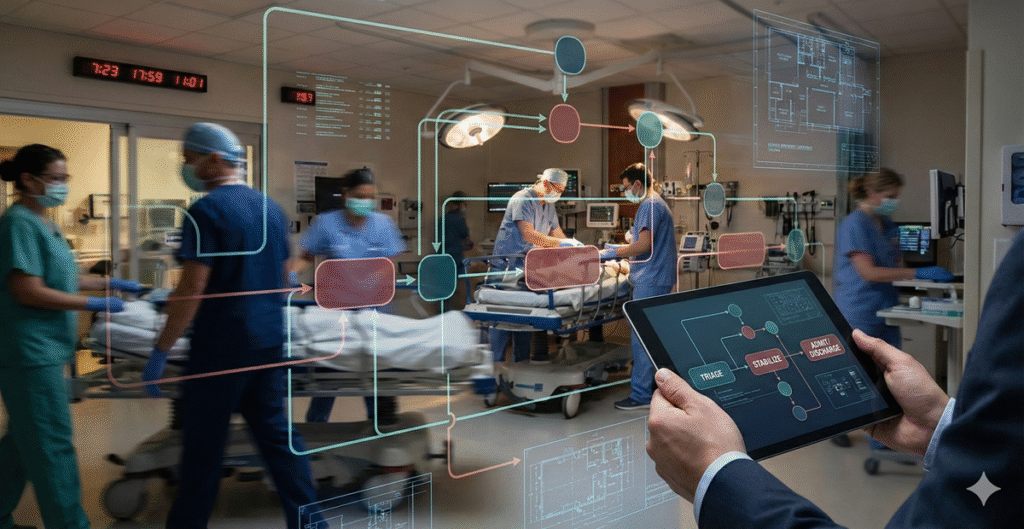
Emergency Departments are not broken because people don’t care.
They are some of the most committed, skilled, and resilient environments you’ll find anywhere. Yet they are also places where delays, congestion, and stress are highly visible, often despite extraordinary individual effort.
That’s precisely why Emergency Departments are such a powerful lens for understanding process design under pressure.
When systems are calm, flaws are easy to hide.
When pressure rises, design is exposed.
Why Emergency Departments Are a Stress Test for Process Design
Emergency Departments operate at the intersection of:
- unpredictable demand,
- fixed capacity,
- complex handoffs,
- and high-stakes decision-making.
Most organisations will never face life-or-death consequences but many experience the same structural conditions:
- demand spikes,
- constrained resources,
- fragmented information,
- and decisions made with incomplete visibility.
Emergency Departments don’t fail because people don’t work hard enough.
They struggle when process design relies on heroics instead of flow.
Under pressure, systems reveal what they were truly built to handle.
Lesson 1: Flow Matters More Than Utilisation
One of the clearest lessons from the Emergency Department series is this:
Optimising individual resources does not optimise the system.
Filling every bed, maximising staff utilisation, or keeping every unit busy often feels efficient. In reality, it can destroy flow.
When downstream capacity is constrained:
- upstream work piles up,
- queues lengthen,
- and decision-making slows.
Emergency Departments improve when leaders focus on end-to-end flow, not local efficiency. The same is true in supply chains, operations centres, service desks, and transformation programs.
Process design under pressure must prioritise movement, not busyness.
Lesson 2: Handoffs Are Where Systems Fail
Under pressure, handoffs become fragile.
In Emergency Departments, delays often occur not at points of care, but:
- between teams,
- between shifts,
- between departments,
- or between decisions.
When information, accountability, or decision rights are unclear, work stalls.
This is not a people problem.
It’s a design problem.
Strong process design under pressure:
- makes ownership explicit,
- reduces ambiguity at interfaces,
- and removes reliance on memory or escalation.
Handoffs don’t fail because people forget.
They fail because the system depends on remembering instead of designing.
Lesson 3: Decision Clarity Beats Decision Speed
Pressure often creates a false urgency to “decide faster.”
In practice, Emergency Departments perform better when:
- decision criteria are clear,
- escalation paths are understood,
- and trade-offs are agreed in advance.
When those conditions exist, decisions happen quickly because they are structured.
When they don’t, speed creates noise.
This lesson applies everywhere:
- pricing decisions,
- customer prioritisation,
- production scheduling,
- and operational triage.
Under pressure, the goal isn’t faster decisions.
It’s clearer decisions that don’t need revisiting.
Why These Lessons Apply Beyond Healthcare
Emergency Departments make process design visible because consequences are immediate.
In most organisations, the same issues exist, they’re just buffered by time, tolerance, or individual effort.
Pressure removes those buffers.
That’s why process design under pressure matters for:
- operations leaders managing demand variability,
- executives navigating transformation,
- teams introducing AI into fragile workflows.
Pressure doesn’t create problems.
It reveals whether the system was ever designed to hold.
Where Leaders Often Misinterpret What They See
When systems struggle under pressure, leaders often respond by:
- adding more people,
- pushing teams harder,
- or introducing new tools.
These responses may provide temporary relief, but they don’t address the underlying design.
Emergency Departments don’t improve sustainably by asking clinicians to care more.
They improve when flow, handoffs, and decisions are designed deliberately.
So do most organisations.
Designing for Pressure, Not for Comfort
Good process design is not about ideal conditions.
It’s about asking:
- what happens when demand spikes,
- where work queues,
- where decisions slow,
- and where clarity disappears.
Systems designed for comfort fail under pressure.
Systems designed for pressure create stability.
A Closing Reflection
Emergency Departments don’t reveal new problems.
They expose existing ones at speed.
The same is true anywhere complexity, variability, and consequence collide.
If your system struggles when pressure rises, the issue is rarely effort or intent.
It’s design.
And design is something leaders can choose to change.