
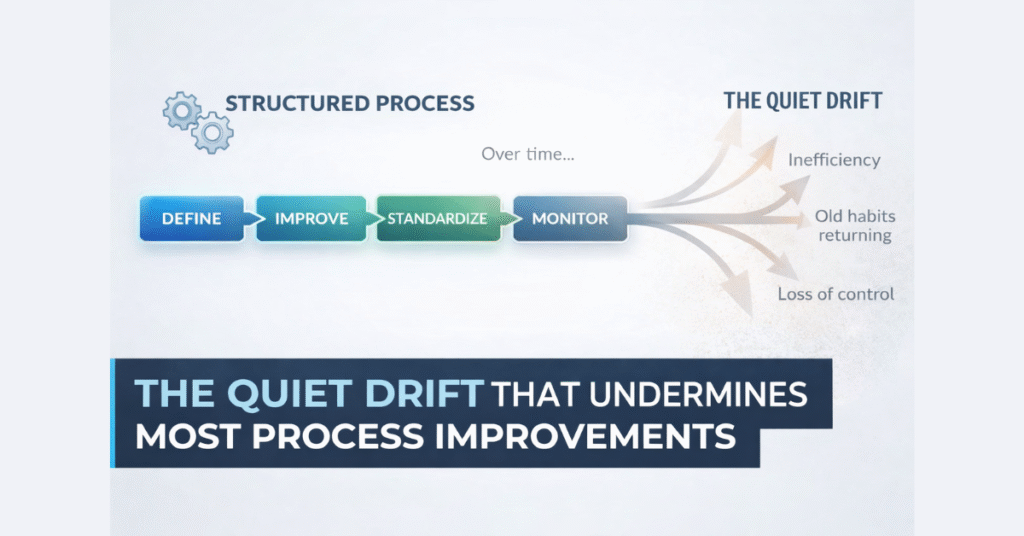
In a recent article, I explored the signs of a structurally sound process improvement program.
But even strong programs can weaken over time.
Many process improvement initiatives begin with real momentum.
Teams invest time mapping processes.
Workshops uncover inefficiencies.
New controls are introduced.
Performance improves.
For a while, the results are visible.
Delays shrink.
Errors reduce.
Teams feel the difference.
Then something subtle begins to happen.
Not immediately.
Not dramatically.
Quietly.
The organisation starts to drift.
Improvement Rarely Fails Overnight
When leaders reflect on improvement initiatives that did not deliver lasting results, the explanation often focuses on familiar themes:
Change resistance.
Competing priorities.
Lack of follow-through.
But in many cases the deeper cause is simpler.
The structure that supported the improvement gradually weakened.
Ownership becomes less visible.
Documentation spreads across different systems.
New hires learn informal shortcuts rather than the intended process.
None of these changes feel significant on their own.
Yet together they slowly reshape how the work is done.
Why Drift Happens
Most organisations design improvement initiatives as projects.
Projects have a beginning.
They have milestones.
They have a conclusion.
Once the project closes, attention moves elsewhere.
Operational environments, however, do not behave like projects.
They evolve constantly.
New systems are introduced.
Demand changes.
Teams grow or reorganise.
Without deliberate reinforcement, even well-designed processes begin to shift.
The improvement has not technically failed.
It has simply lost the structure that once held it in place.
The Role of Structure
Healthy improvement environments share one important characteristic.
They do not rely solely on enthusiasm or memory.
They rely on structure.
Structure provides:
Clarity of ownership.
Visibility of performance.
Traceability between decisions and outcomes.
When these elements remain visible, improvement can endure.
When they fade, teams often revert to the practices that feel easiest in the moment.
Over time, those small adjustments accumulate.
The process no longer resembles the one that was originally improved.
When Technology Meets Drift
This pattern becomes particularly important as organisations introduce more automation and artificial intelligence.
Technology is remarkably effective at scaling what already exists.
If the underlying process is disciplined and visible, automation strengthens performance.
If the underlying process is drifting, technology simply accelerates that drift.
In other words, automation does not stabilise a process.
It amplifies its current state.
How Process Improvement Drift Begins
One of the most valuable capabilities leaders can develop is the ability to recognise the early signals of process drift.
These signals rarely appear as dramatic failures.
More often they show up as:
Subtle delays returning.
Workarounds quietly spreading.
Ownership becoming less clear.
Documentation becoming harder to locate.
Each signal seems minor in isolation.
Together they reveal that the structure supporting the improvement is beginning to loosen.
Sustaining Improvement
Sustaining improvement is not about repeating the original project.
It is about maintaining the conditions that allow improvement to hold.
That means preserving clarity around:
Who owns the process.
How performance is monitored.
Where risks are controlled.
How changes are absorbed into the operating model.
When these elements remain visible, improvement becomes something more powerful than a project.
It becomes a capability.
A Final Thought
Organisations rarely lose their improvements because people stop caring.
More often, the systems designed to support those improvements simply fade into the background.
Process improvement does not fail in a single moment.
It fades through a series of small, almost invisible shifts.
Leaders who understand this dynamic focus not only on improving processes, but on maintaining the structures that allow those improvements to endure.
Because in the end, sustainable performance is not created by a single initiative.
It is created by the discipline to keep the structure intact long after the project is finished.