
For the past few years, the pressure on leadership teams has been clear: move faster on AI and automation.
Boards have approved investment. Automation programs have been established. AI pilots have multiplied. Technology budgets have grown.
Now the conversation is changing.
The question is no longer simply:
“What are we doing with AI?”
Increasingly, it is becoming:
“Where is the value?”
For management teams, that creates a different challenge.
It is relatively easy to identify processes that can be automated. It is much harder to determine which processes should be automated, which will deliver meaningful business value, and whether they are actually ready for automation.
That is the automation readiness gap.
Automatable Does Not Mean Ready to Automate
Most organisations have no shortage of potential automation opportunities.
Manual data entry. Approvals. Reporting. Customer requests. Reconciliations. Handoffs between systems. Administrative tasks performed repeatedly by experienced people.
The temptation is understandable: identify repetitive work, apply technology and calculate the hours potentially saved.
But a process being technically automatable tells us very little about whether it is a good candidate for automation.
Before automating a process, we need to understand how it actually performs today.
Where are the delays?
Where does rework occur?
Which activities genuinely add value?
Where are the unnecessary approvals and handoffs?
What exceptions occur, and why?
Where have employees developed workarounds because the formal process does not reflect operational reality?
And, importantly, what problem are we actually trying to solve?
Without answering those questions first, automation can make an inefficient process faster without making it better.
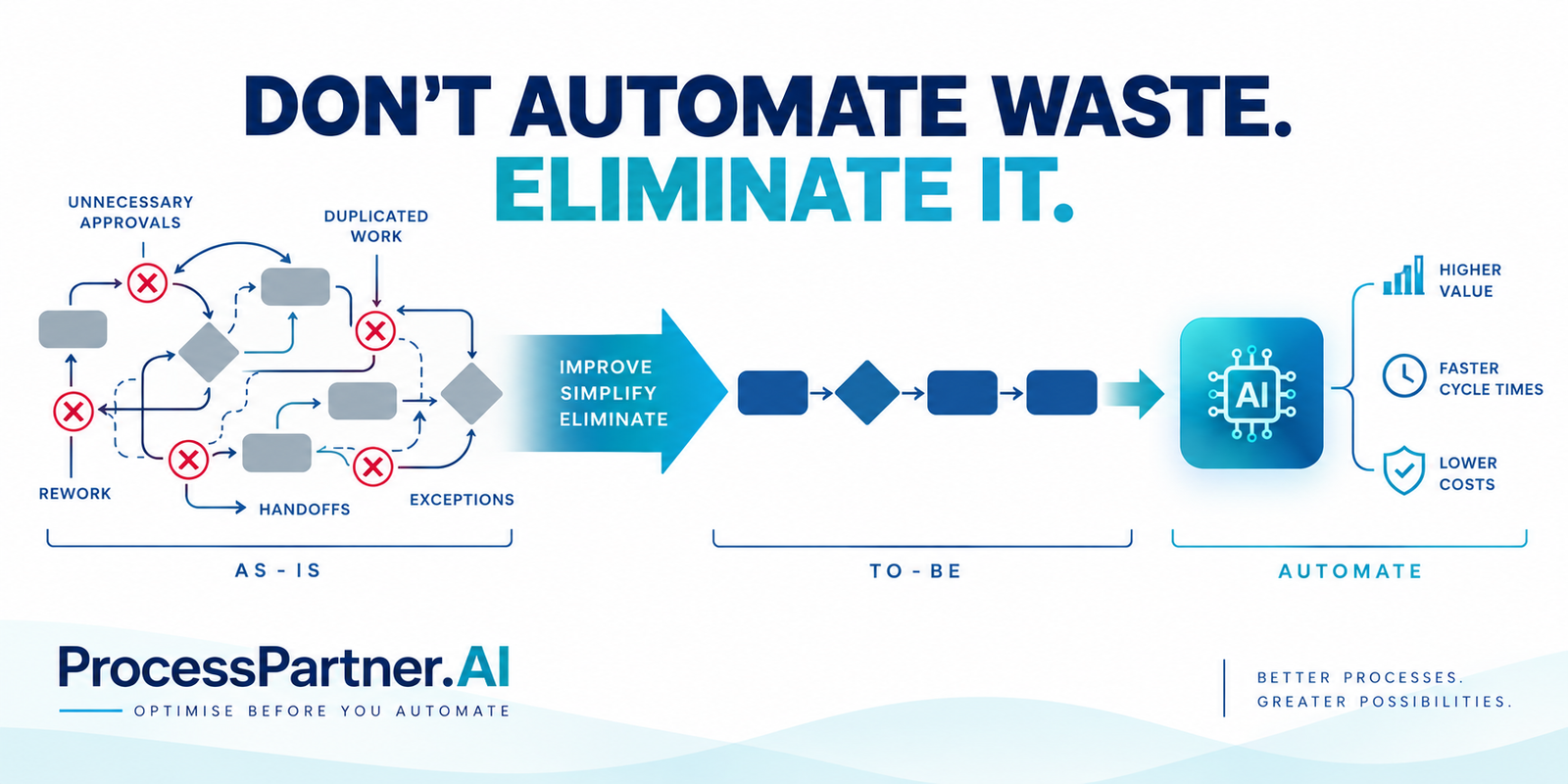
Don’t Automate Waste. Eliminate It.
There is a long-standing principle in process improvement: do not automate waste.
But in an environment of rapidly expanding AI and automation capability, we need to go further:
Don’t automate waste. Eliminate it.
If a process contains unnecessary approvals, duplicated effort, poorly defined decision points, avoidable rework or recurring exceptions, the first question should not be how technology can perform those activities faster.
The first question should be:
Why do those activities exist at all?
In a manual environment, process problems are often highly visible.
People complain about them. Work queues build up. Spreadsheets appear. Employees create workarounds. Managers intervene when something goes wrong.
Now automate that process without first challenging its design.
The unnecessary approval becomes a workflow rule.
The duplicate activity becomes an integration.
The exception becomes another branch in the automation.
The workaround becomes a system requirement.
The underlying waste has not disappeared.
It has been encoded.
What was once process debt can become technology debt.
And once unnecessary complexity is embedded across workflows, integrations, business rules and systems, removing it later may be considerably harder and more expensive than eliminating it before automation.
The Automation Selection Problem
There is another challenge.
Even if an organisation accepts that processes should be improved before they are automated, it still needs to decide where to start.
The most visible process is not necessarily the most valuable.
The process generating the most complaints is not necessarily the one creating the greatest cost.
And the process that is easiest to automate may not be the process capable of generating the greatest strategic return.
Automation portfolios therefore need more than a pipeline of ideas.
They need a disciplined way to evaluate processes against factors such as cost, customer impact, process performance, failure demand, rework, risk, capacity constraints and strategic importance.
Only then can management distinguish between:
What can be automated.
What should be automated.
What is ready to be automated.
That distinction becomes increasingly important as organisations move beyond isolated AI experiments and begin making larger investment decisions.
Process Improvement Is Becoming More Important, Not Less
It would be easy to assume that advances in AI will reduce the need for traditional process improvement capability.
I believe the opposite is happening.
The more powerful automation becomes, the greater the consequences of applying it to the wrong process or applying it too early.
Lean Six Sigma, DMAIC and continuous improvement provide something technology alone cannot: a disciplined framework for understanding how work is performed, measuring performance, identifying root causes, improving the underlying process and ensuring that improvements are sustained.
AI can dramatically accelerate parts of that work.
It can help teams analyse information, identify patterns, generate improvement artefacts and reduce the administrative burden that has traditionally made structured process improvement difficult to scale.
But it does not remove the need for process discipline.
AI can accelerate improvement. It should not replace the thinking behind it.
From Automation Pipeline to Improvement Pipeline
Perhaps the bigger shift for management teams is therefore not technological at all.
Instead of asking:
“What can we automate?”
organisations should first ask:
“Which processes are preventing us from achieving the outcomes we need?”
That creates a very different pipeline.
Processes can be identified, assessed and prioritised according to business value. Their current performance can be understood. Waste and root causes can be addressed. The process can be redesigned. Controls can be established.
Then automation can be applied where it genuinely improves the outcome.
This does not slow automation down.
It gives automation somewhere worthwhile to go.
And it gives boards something far more meaningful to measure than the number of AI pilots launched or processes automated: tangible improvement in business performance.
Optimise Before You Automate
The first phase of enterprise AI adoption was understandably dominated by experimentation.
The next phase will be about value realisation.
As boards ask harder questions about returns on AI and automation investment, management teams will need better answers about where technology should be applied and why.
That makes continuous improvement capability increasingly important.
Because the objective was never to automate more processes.
The objective is to build a better-performing organisation.
Don’t automate waste.
Eliminate it. Then automate what remains.
Optimise before you automate.