
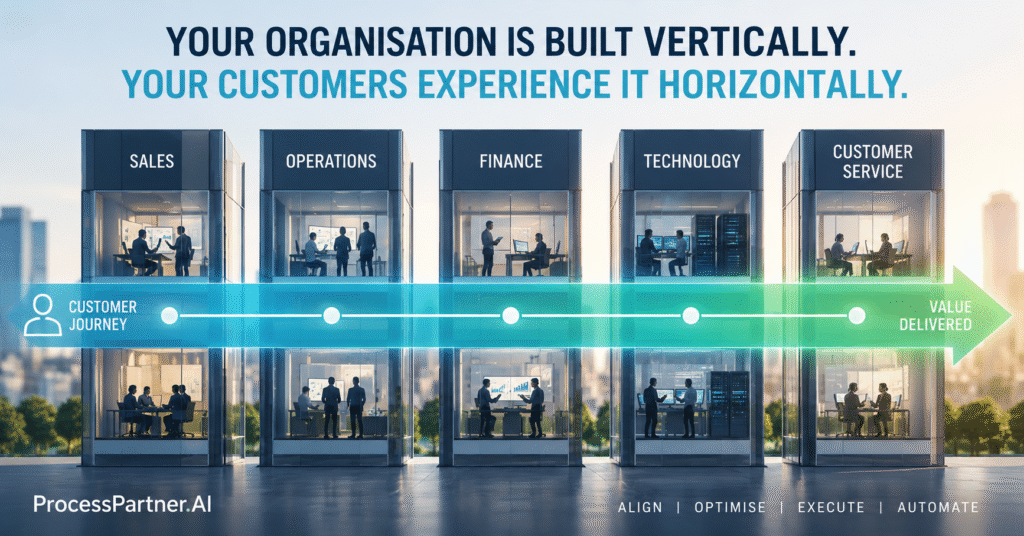
Most organisations are built vertically.
Sales.
Operations.
Finance.
Technology.
Customer Service.
Each function has its own leadership, priorities, systems and performance measures.
It makes sense from an organisational perspective.
But customers do not experience organisations vertically.
Their experience moves horizontally, across every one of those boundaries.
A customer request might begin with Sales, move through Operations, require approval from Finance, depend on Technology, and ultimately be delivered through Customer Service.
To the customer, that is not five functions.
It is one experience.
And that creates an important challenge for leaders.
How do you manage execution horizontally when the organisation itself is managed vertically?
The Problem Is Often Between the Functions
Most organisations have spent years improving individual functions.
Finance becomes more efficient.
Operations reduces costs.
Sales improves conversion.
Technology increases delivery speed.
Each function can be performing well against its own objectives while the end-to-end process is still underperforming.
Why?
Because many of the biggest sources of friction exist between functions rather than within them.
Handoffs create delays.
Different priorities create competing decisions.
Information gets entered more than once.
Ownership becomes unclear when work crosses boundaries.
Teams create workarounds to compensate.
None of this necessarily appears on a functional dashboard.
Sales may have completed its task on time. Operations may be meeting its KPI. Finance may be operating within its service level.
Yet the customer is still waiting.
This is the difference between functional performance and end-to-end performance.
Local Optimisation Can Still Produce a Poor System
There is a natural tendency for leaders to optimise what they control.
It is understandable.
Leaders are given functional objectives, budgets and teams. They are measured against those responsibilities.
But optimising individual parts of a system does not guarantee that the overall system improves.
Sometimes it does the opposite.
A policy that makes one department more efficient may create additional work somewhere else.
A new system might remove effort from one team while introducing another handoff downstream.
A tighter control might reduce risk locally while significantly increasing cycle time across the process.
From within each function, the decisions can appear entirely rational.
From an end-to-end perspective, the process becomes more complicated.
That is why some organisations can have highly capable teams and sophisticated technology while customers and employees still experience unnecessary friction.
Customer Value Flows Horizontally
If we want to understand where performance is really created, we need to follow the work.
Not the organisational chart.
Take something as simple as resolving a customer issue.
The work may cross several teams, systems and decision points before the issue is resolved.
Every transition introduces potential friction:
Is the required information available?
Does the next person know the work is waiting?
Is responsibility clear?
Are decisions being made consistently?
Does everyone understand the outcome the process is supposed to achieve?
These questions are difficult to answer when each function only sees its own part of the journey.
End-to-end visibility changes that.
Instead of asking:
“How is my department performing?”
leaders can also ask:
“How effectively is value moving through the organisation?”
That is a very different management question.
From Integrated Planning to Integrated Execution
Organisations have become increasingly sophisticated at integrating how they plan.
Strategies are aligned with budgets.
Forecasts connect demand with resources.
Technology roadmaps support business priorities.
Enterprise planning increasingly attempts to bring different parts of the organisation together.
But execution often remains fragmented.
The strategy may be integrated.
The budget may be integrated.
The plan may be integrated.
Yet when the work begins, execution falls back into functional boundaries.
That creates an opportunity.
I believe the next significant performance leap for many organisations will come from becoming better at integrated execution.
Not removing functional expertise or accountability.
Connecting it.
What Integrated Execution Looks Like
Integrated execution does not require another layer of bureaucracy.
It requires greater clarity around how work moves across the organisation.
At a practical level, that means being able to see:
- where processes cross functional boundaries
- who owns the end-to-end outcome
- where delays and rework are occurring
- how risks and controls connect to the process
- whether improvements in one area create consequences elsewhere
- whether performance gains are sustained over time
It also means giving teams a common way to improve those processes.
When every function uses different methods, documents and systems to manage improvement, fragmentation simply moves from operations into the improvement effort itself.
A shared improvement discipline creates a common language.
And that makes cross-functional execution easier to manage.
Align. Optimise. Execute. Automate.
As organisations accelerate their investment in AI and automation, the sequence becomes increasingly important.
Technology can move work faster.
But faster execution of a fragmented process does not necessarily create a better outcome.
A more sustainable sequence is:
Align
Understand the outcome the process needs to deliver and how that outcome supports organisational priorities.
Optimise
Examine the end-to-end process, including the handoffs, constraints, risks and waste that exist between functions.
Execute
Put clear ownership, governance, controls and performance visibility around the improved process so the new way of working can hold.
Automate
Then use technology and AI to accelerate the parts of the process where automation genuinely creates value.
The objective is not to delay automation.
It is to give automation something worth scaling.
The Role of AI
AI makes this conversation more important, not less.
As AI becomes capable of performing increasingly complex work across organisational boundaries, the quality of the underlying process architecture matters enormously.
An AI agent does not care which department owns a task.
It follows the workflow, data, rules and permissions it has been given.
That creates enormous potential to remove friction between functions.
But it also means that unclear ownership, unnecessary steps and poorly designed controls can be embedded into automated execution remarkably quickly.
The organisations that benefit most from AI may therefore not be those that automate first.
They may be those that understand their end-to-end processes best.
A Different View of Operational Excellence
Operational excellence has traditionally focused heavily on improving efficiency within processes.
That remains important.
But there is a larger opportunity.
When organisations improve how work moves between functions, they can reduce friction that no single department can solve independently.
That can mean:
Faster decisions.
Less rework.
Clearer accountability.
Better customer experiences.
More productive use of technology.
And importantly, greater capacity for innovation and growth.
That is where process improvement moves beyond cost reduction.
It becomes part of how the organisation executes its strategy.
A Final Thought
Organisational structures will probably remain vertical.
They exist that way for good reasons.
But value will continue to move horizontally.
The challenge for leaders is not to choose between the two.
It is to connect them.
Because your customer does not see Sales, Operations, Finance, Technology and Customer Service.
They see one organisation.
And ultimately, they judge that organisation by how well all of those parts work together.
The next frontier of operational excellence may not be improving each function further.
It may be integrating how the entire organisation executes.