
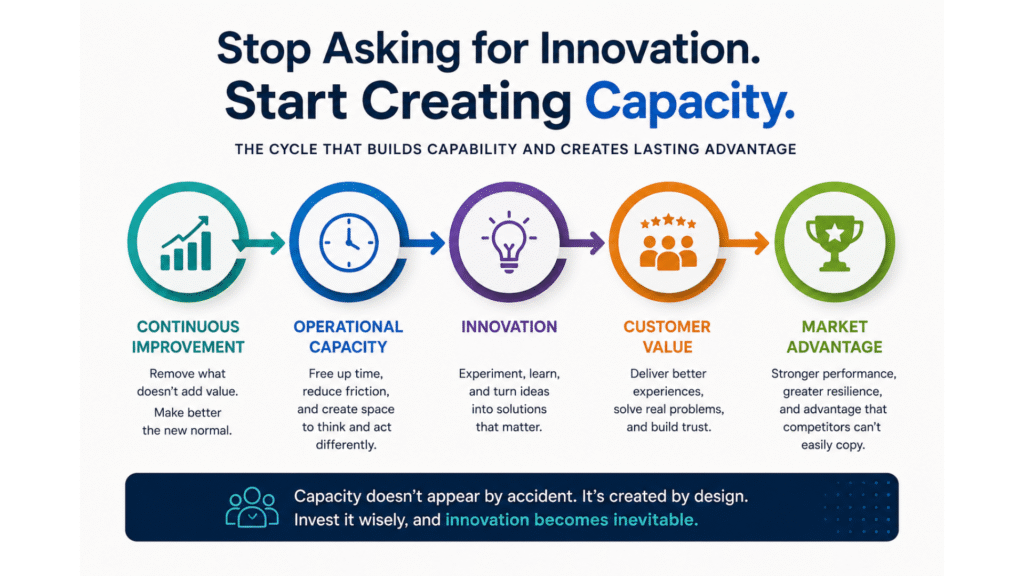
A Practical Framework for Building Innovation Through Operational Excellence
Innovation has become one of the most overused words in business.
Every organisation wants more of it.
Leaders encourage teams to think differently. Innovation workshops are scheduled. Suggestion boxes are launched. Cross-functional brainstorming sessions are held.
Yet many organisations struggle to convert good ideas into meaningful business outcomes.
Why?
Because innovation doesn’t fail due to a lack of creativity.
It fails because organisations rarely create the capacity required to make innovation part of everyday work.
Innovation Requires More Than Good Ideas
Consider a typical operational team.
Managers are approving requests.
Subject matter experts are answering the same questions repeatedly.
Teams are resolving customer issues, attending meetings and responding to emails.
Everyone is busy.
Everything important gets done.
But very little time remains to explore new ideas, test different approaches or improve the way work is performed.
Innovation becomes something people are expected to do after they’ve finished everything else.
Unfortunately, that moment rarely arrives.
The most innovative organisations don’t simply encourage innovation.
They deliberately create the operational capacity that makes innovation possible.
Start With the End in Mind
One of the biggest mistakes organisations make is treating process improvement purely as an efficiency exercise.
Reduce waste.
Shorten cycle times.
Improve productivity.
These are worthwhile objectives, but they shouldn’t be the destination.
Before launching an improvement initiative, ask a different question:
“What will we do with the capacity we create?”
Perhaps the answer is:
- Develop new products or services.
- Improve customer experience.
- Enter new markets.
- Strengthen supplier relationships.
- Reduce employee workload and burnout.
- Give frontline teams time to solve long-standing operational problems.
When leadership defines the purpose of regained capacity from the outset, every improvement project becomes a strategic investment rather than simply another efficiency program.
Step 1: Identify the Processes Limiting Capacity
The opportunities already exist within your organisation.
The challenge is recognising them.
Start by listening to the people closest to the work.
Frontline employees know where delays occur, where information is missing and where unnecessary effort has become accepted as “just the way we do things.”
Then broaden your perspective by examining multiple sources of evidence, including:
- Voice of Customer (customer complaints, surveys and CSAT results)
- Process mining and workflow analytics
- Operational dashboards and KPI trends
- Cycle times and waiting periods
- Escalations, defects and rework
- Employee feedback and recurring pain points
The objective isn’t simply to collect data.
It’s to build an evidence-based understanding of where operational capacity is being consumed unnecessarily.
Step 2: Validate, Quantify and Prioritise
Not every problem deserves immediate attention.
Effective organisations evaluate opportunities objectively.
Ask questions such as:
- How frequently does the problem occur?
- What is the impact on customers?
- How much time or cost does it consume?
- Does it create operational risk?
- Will solving it release meaningful capacity?
Prioritisation ensures improvement effort is focused where it will create the greatest strategic value.
Step 3: Solve Root Causes, Not Symptoms
Many organisations become trapped in a cycle of temporary fixes.
They solve today’s issue only to encounter it again next month.
Sustainable improvement requires understanding why the problem exists in the first place.
Structured improvement approaches such as DMAIC provide a disciplined way to investigate root causes, validate assumptions and implement corrective actions that address underlying process weaknesses rather than treating symptoms.
The goal isn’t simply to fix a process.
It’s to improve the capability of the operating model itself.
Step 4: Protect the Gains
Creating capacity is only half the challenge.
Keeping it is where many organisations struggle.
Without monitoring, governance and clear ownership, old behaviours often return and performance gradually declines.
Sustainable organisations establish:
- Process performance measures
- Monitoring and response plans
- Clear ownership and accountability
- Standard operating procedures
- Regular process reviews
Improvement should become part of daily operations, not a project that concludes when the implementation team leaves.
Step 5: Combine AI With Process Improvement
Artificial Intelligence has enormous potential to accelerate operational performance.
It can automate repetitive work, analyse large volumes of information and support faster decision-making.
However, AI alone cannot compensate for poor process design.
Automating unnecessary work simply allows inefficiency to happen faster.
Likewise, improving processes without taking advantage of AI often leaves skilled employees performing repetitive administrative tasks that technology could easily support.
Together, AI and disciplined process improvement become a powerful combination.
AI accelerates work.
Well-designed processes ensure that work creates value.
Together, they create organisational capacity.
Step 6: Reinvest Capacity Into Innovation
This is the step many organisations overlook.
Once operational capacity has been created, it shouldn’t simply disappear into more meetings, more reporting or more reactive work.
It should be deliberately reinvested.
Create structured opportunities for innovation by:
- Involving frontline employees in idea generation
- Collaborating with customers and suppliers
- Running small experiments before large-scale change
- Measuring outcomes and learning quickly
- Embedding innovation into leadership and development programs
Innovation becomes far more sustainable when it is supported by operational capacity rather than dependent on individual enthusiasm.
Building an Operating Model That Improves Itself
Over time, organisations that consistently improve develop a self-reinforcing cycle.
Continuous improvement creates operational capacity.
Operational capacity enables innovation.
Innovation delivers greater customer value.
Customer value strengthens competitive advantage.
Rather than viewing process improvement as a one-off initiative, leading organisations build it into the way they operate.
The result isn’t simply greater efficiency.
It’s a more capable organisation that continuously adapts, learns and creates value.
Final Thoughts
Technology can be copied.
Products can be replicated.
Even AI capabilities quickly become widely available.
What competitors cannot easily copy is an organisation that has built an operating model capable of continuously creating capacity and reinvesting it into innovation.
That’s where long-term competitive advantage is created.
If your organisation recovered 10% of its operational capacity tomorrow, would you already know exactly where you would invest it?
If not, perhaps the first step isn’t asking for more innovation.
Perhaps it’s creating the capacity that makes innovation possible.
Ready to Create Capacity for Innovation?
At ProcessPartner.AI, we help organisations identify operational constraints, prioritise improvement opportunities and apply a structured, AI-guided approach to sustainable process improvement.
If you’re looking to create strategic capacity rather than simply improve efficiency, we’d love to show you how.
Book an Operational Review to explore where your organisation could create the capacity needed for its next stage of growth.