
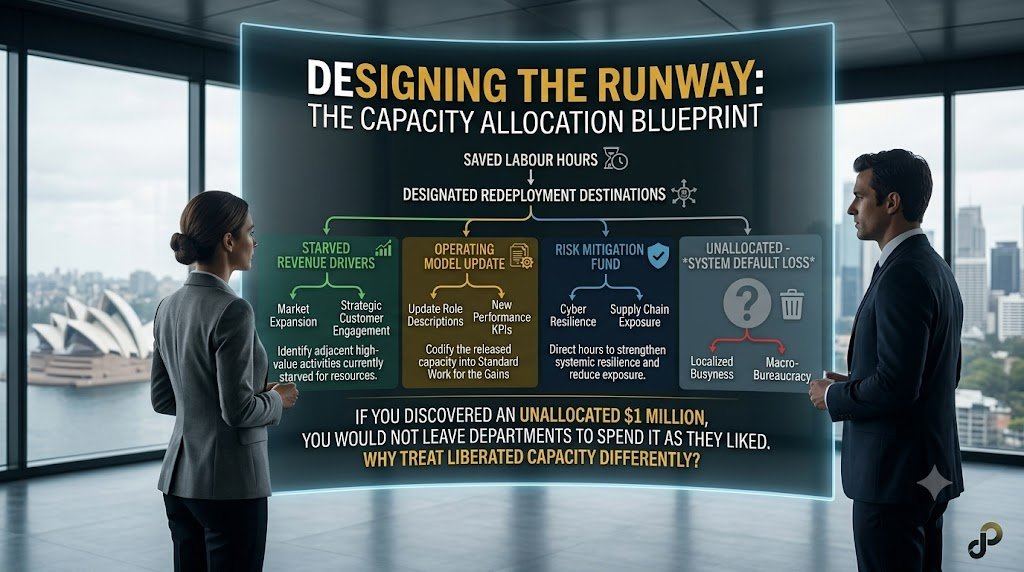
When an enterprise deploys AI or optimizes a core operational process, the initial metrics look stellar. We routinely see reports of 20% to 30% time savings on specific administrative tasks.
But if leadership doesn’t explicitly build a runway for that saved time to land on, the organization’s operating model will simply find a new way to spend it. Micro-tasks are eliminated; macro-bureaucracy takes their place.
The report that used to take three hours now takes one. The remaining two hours silently vanish into another status meeting, another dashboard, or a beautifully formatted deck that no one actually needs.
The problem isn’t that your people want to create bureaucracy. The problem is mechanical: unallocated capacity never stays vacant. If you don’t intentionally direct released time, the system automatically defaults to localized busyness.
To break this loop, leadership teams must stop treating process improvement as a technology or workflow exercise, and start treating it as a resource allocation strategy.
Here is a three-step framework to audit, capture, and intentionally redirect liberated capacity before it disappears.
1. Audit the Deficit, Not Just the Savings
Most process optimization projects begin by asking: “How much time can we save here?”
That is only half the equation. Before you optimize a single workflow, you must look at the adjacent high-value activities that are currently starved for resources. Ask your frontline leaders:
- If your team suddenly had an extra 10 hours a week, what critical, non-administrative work would they immediately tackle?
- What client-facing, strategic, or risk-mitigation tasks are currently being neglected due to “firefighting”?
By identifying the capacity deficit first, you create an immediate, high-value destination for the time your optimization project is about to unlock. You design the runway before the plane takes off.
2. Implement “Standard Work” for the Gains
In manufacturing, Standard Work ensures that a process is executed the same way every time to maintain quality and efficiency. In the corporate office, we need Standard Work for the gains.
If an automation initiative frees up 15% of a department’s capacity, that gain must be codified into the operating model. This means updating:
- Role Descriptions: Explicitly shifting the percentage of time allocated to administrative execution versus strategic analysis or customer engagement.
- Performance Metrics (KPIs): Changing what success looks like. If a tool makes data entry instant, the employee should no longer be measured on output volume, but on the speed and quality of the decisions made using that data.
If your job expectations and performance metrics don’t change after a major process improvement, your operating model hasn’t actually evolved. You’ve just made looking busy much more efficient.
3. Establish a Capitalization Gateway
Many organizations run into trouble because they approve process improvement and AI projects based entirely on projected efficiency metrics.
To protect your bottom line, introduce a simple rule to your transformation governance: No process improvement or automation project gets approved for deployment unless there is a pre-signed agreement on who owns and directs the freed capacity.
If a project sponsor claims a tool will save 500 hours a month across a division, they must document exactly how those 500 hours will be converted into market growth, risk reduction, or margin improvement. If they cannot define the destination, the project shouldn’t pass the gateway.
The Strategic Shift
Technology can optimize your execution. Lean methodologies can strip out waste. But neither can dictate how your organization utilizes the space they create.
The true competitive advantage of the next decade won’t belong to the companies that automate the fastest. It will belong to the leadership teams that master the art of capacity capitalization.
Stop celebrating time saved as an endpoint. It is merely the raw material. The real work begins when you decide exactly what that time is supposed to achieve.