
Ask an operations team what poor quality costs them and you will usually get a pause, then a guess.
That pause is the problem. The cost of poor quality is rarely a line item. It is spread across rework nobody logs, corrections made quietly by colleagues, complaints handled by a different team, and customers who simply stop coming back.
According to ASQ, many organisations have quality-related costs as high as 15 to 20% of sales revenue. Most of it stays invisible until someone goes looking.
This guide explains what the cost of poor quality (COPQ) is, how quality costs are categorised, and a practical five-step way to put a first number on it for one process. It also explains why that number matters even more before you automate.
What is the cost of poor quality?
ASQ defines the cost of poor quality as the costs associated with providing poor quality products or services. In plain terms, it is what you spend because work was not done right the first time.
In a factory, that might be scrap and rework. In an office or service environment it looks different, but it costs just as much:
- Re-keying data that was entered incorrectly
- Chasing missing information before work can continue
- Handling complaints, refunds and credit notes
- Investigating the same incident more than once
- Duplicated effort when two teams work on the same problem without knowing it
The four cost of quality categories
ASQ groups quality costs into four categories. Two are about preventing and catching problems. Two are the cost of the failures themselves.
Prevention costs
Costs incurred to keep failure and appraisal costs to a minimum, such as quality planning, process design and training.
Appraisal costs
Costs of checking whether work meets requirements, such as inspections, audits and reviews.
Internal failure costs
Costs of defects found before the customer receives the product or service: rework, corrections, unnecessary work and investigating why failures happened.
External failure costs
Costs of defects found after the customer receives it: complaints, returns, repairs and warranty claims. These tend to hurt the most, because they cost you trust as well as money.
When people talk about the cost of poor quality, they usually mean the two failure categories. Prevention and appraisal are the investment that keeps those failure costs down.
How to calculate COPQ for one process in five steps
You do not need a finance team or a months-long study to get started. A rough first estimate for one process is enough to show where the money is going.
1. Pick one process
Choose a process that is busy and visibly painful, such as incident management, invoice processing, customer onboarding or order fulfilment. One process, not the whole organisation. Keeping the scope small is what makes this achievable.
2. List what goes wrong
Walk the process with the people who do the work (a Gemba walk) and list every failure you see or hear about. Split them into internal failures, which are caught before the customer notices, and external failures, which the customer feels.
3. Count how often it happens
Track each failure over a set period, such as a month. Use system data where it exists and a simple tally where it does not. A data collection plan helps: for each item, agree what will be measured, how, how often and who is responsible.
4. Put a cost on each one
For time-based failures, multiply the hours spent by a loaded hourly rate. Then add any direct costs, such as refunds, write-offs, penalties or expedited delivery. Where you have to estimate, write the assumption down so it can be checked later.
5. Add it up and compare
Total the costs by category and compare them with the volume the process handles. A cost per transaction, per case or per month is easier to act on than one large number. You now have a baseline.
It will not be perfect. It does not need to be. A rough baseline beats no baseline, every time.
A worked example: incident management
Here is how this looks in practice, using a sample incident management project in ProcessPartner.AI. The figures below come from a demo project and are illustrative, not from a real organisation.
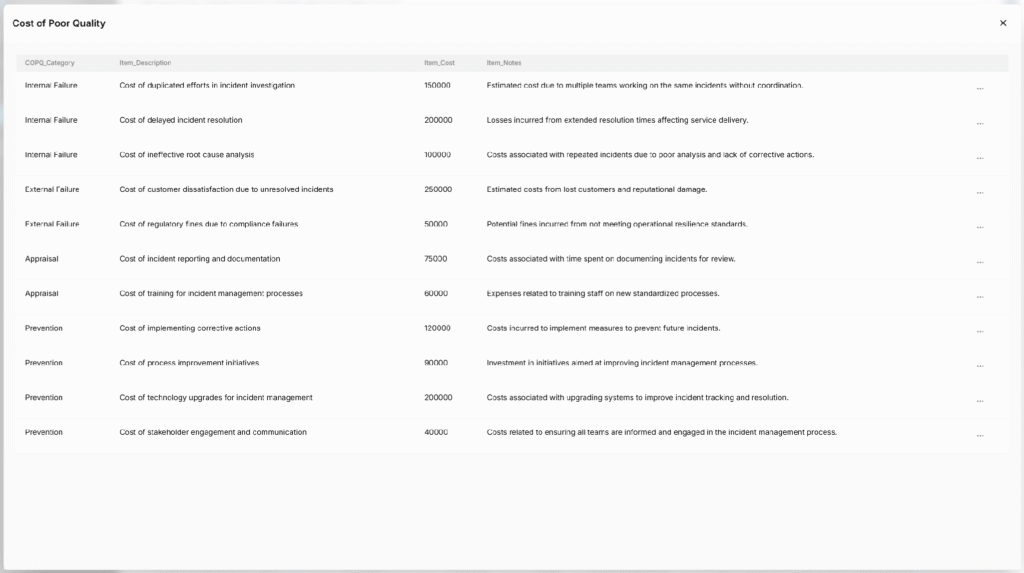
The Cost of Poor Quality table in the Measure phase of ProcessPartner.AI (sample project).
Internal failure costs include duplicated effort when several teams investigate the same incident, delayed resolution, and repeat incidents caused by weak root cause analysis. External failure costs include customer dissatisfaction from unresolved incidents and potential regulatory fines. Appraisal and prevention costs cover incident documentation, training, corrective actions and improvement work.
In this sample, failure costs add up to 750,000, compared with 585,000 spent on appraisal and prevention. The largest single item is an external cost, customer dissatisfaction, rather than any of the internal problems the team deals with day to day.
That is the real value of the exercise. Once the cost is visible, the conversation moves from opinion to evidence.
Why measure COPQ before you automate?
Automation changes how fast a process runs. On its own, it does not change whether the process is right.
If you automate without a baseline:
- You cannot prove the automation delivered value, because you never knew what the process cost before.
- You risk building existing failures into new workflows and integrations, where they are harder and more expensive to remove.
- You may automate the wrong process entirely, while a more expensive problem sits untouched next door.
Measuring COPQ first gives you a way to prioritise. Start with the processes where poor quality costs the most, fix the causes, and then decide what is worth automating. We explore this in more detail in The Automation Readiness Gap.
How ProcessPartner.AI helps
ProcessPartner.AI guides teams through each phase of DMAIC: Define, Measure, Analyse, Improve and Control. In the Measure phase, your team can build a cost of poor quality breakdown and a data collection plan for a process in one place, alongside the efficiency and effectiveness measures that show whether a change actually worked.
AI helps generate a first draft from your project context. Your team then reviews it, challenges it and signs it off. No Lean Six Sigma background is needed to get started.
Start your first improvement project free at processpartner.ai.
Key takeaways
- The cost of poor quality is the cost of not doing work right the first time.
- ASQ notes that quality-related costs can reach 15 to 20% of sales revenue in many organisations.
- Start with one process: list its failures, count them, cost them and add them up.
- Measure before you automate, so you know what to fix first and can prove what changed.