
Every organisation wants to be more efficient.
We map workflows, eliminate redundant steps, run automation workshops, and deploy AI tools. We celebrate when a team reduces the time required to complete a core administrative task by 20%.
The project is marked green on the transformation dashboard.
But when leadership reviews the financial results a quarter later, a frustrating reality often emerges.
Revenue hasn’t increased.
Operating costs haven’t fallen.
Margins remain unchanged.
This isn’t a failure of the improvement initiative.
It’s a failure to capture the value it created.
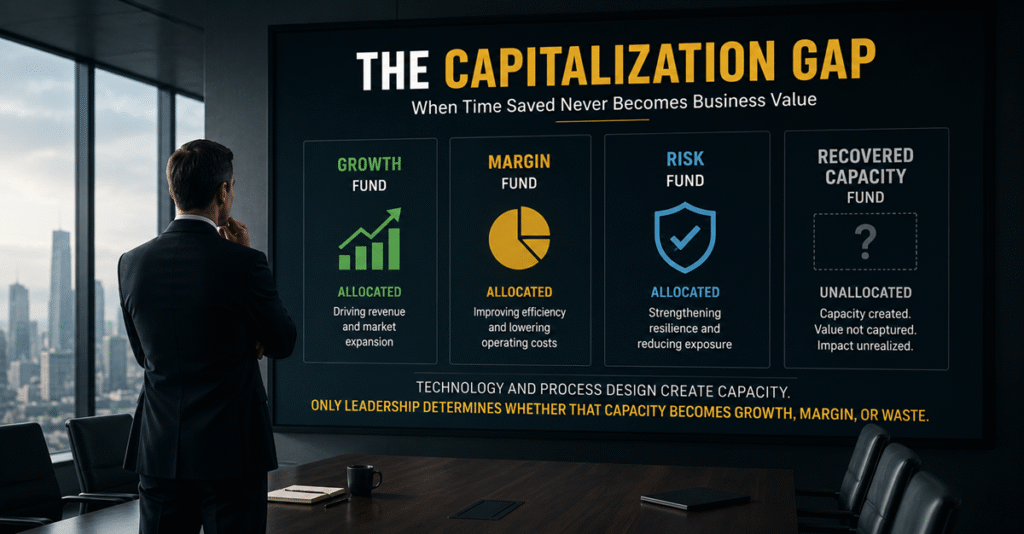
I call this The Capitalization Gap.
The Capitalization Gap is the distance between time saved and value realised.
It is one of the most common reasons process improvement programs struggle to demonstrate meaningful business impact, even when the underlying initiatives are successful.
The Vacuum of Unallocated Time
The fundamental mistake many organisations make is treating time saved as an automatic business outcome.
It isn’t.
Time saved is simply an input.
When an operational improvement or AI tool successfully frees up three hours a week for an employee, that time does not automatically convert into growth, margin improvement, or strategic advantage.
If leadership does not deliberately redirect that capacity, the organisation absorbs it back into everyday activity.
The employee remains just as busy, but the recovered time gradually disappears into:
Activity Expansion
More reports, dashboards, updates, and administrative tasks simply because they are now easier to create.
Perfectionism Inflation
Additional effort spent refining work that was already good enough.
Meeting Multiplication
Calendar growth driven by reduced friction rather than genuine business need.
The individual feels productive.
The organisation feels busy.
But nothing meaningful has changed.
Efficiency has been created.
Strategic capacity has not.
Capacity Creation Is Not Business Value
Most improvement programs stop at the point where efficiency is achieved.
The organisations that outperform understand there is another step.
Capacity Creation
Process improvement and automation reduce effort.
↓
Capacity Release
Hours become available.
↓
Capacity Capitalization
Leadership deliberately reallocates those hours toward strategic outcomes.
Without the final step, efficiency gains rarely translate into measurable business performance.
Treat Capacity Like Capital
Imagine discovering an unallocated million dollars in your operational budget.
You wouldn’t leave it sitting on the table for teams to spend however they chose.
You would allocate it intentionally.
You would direct it toward initiatives with a clear return on investment.
Recovered labour hours deserve exactly the same discipline.
When process improvement or automation unlocks capacity, leadership must explicitly decide where those hours will be reinvested.
In practice, capacity should be directed into one of three strategic growth levers.
1. Market Growth
Shift frontline staff away from administrative execution and toward business development, client retention, and market expansion activities that drive revenue.
2. Risk and Quality
Redirect operational teams toward root cause analysis, process auditing, capability development, and innovation that strengthens resilience and reduces future failure costs.
3. Margin Improvement
Restructure operating models, reduce contractor dependence, consolidate activities, or eliminate unnecessary effort to directly lower operating expenses.
The destination should be different for every organisation.
The discipline of choosing the destination should not.
Moving Beyond Surface-Level Efficiency
Technology can optimise execution.
Lean methodologies can remove waste.
Automation can reduce effort.
None of them can determine how newly created capacity is used.
That responsibility belongs to leadership.
If an organisation’s operating model does not explicitly structure, measure, and direct human capacity, process improvement will continue to be viewed as a cost centre rather than a growth engine.
The organisations creating sustainable competitive advantage understand a simple truth:
Technology and process design create capacity.
Only leadership can determine whether that capacity becomes growth, margin, or waste.